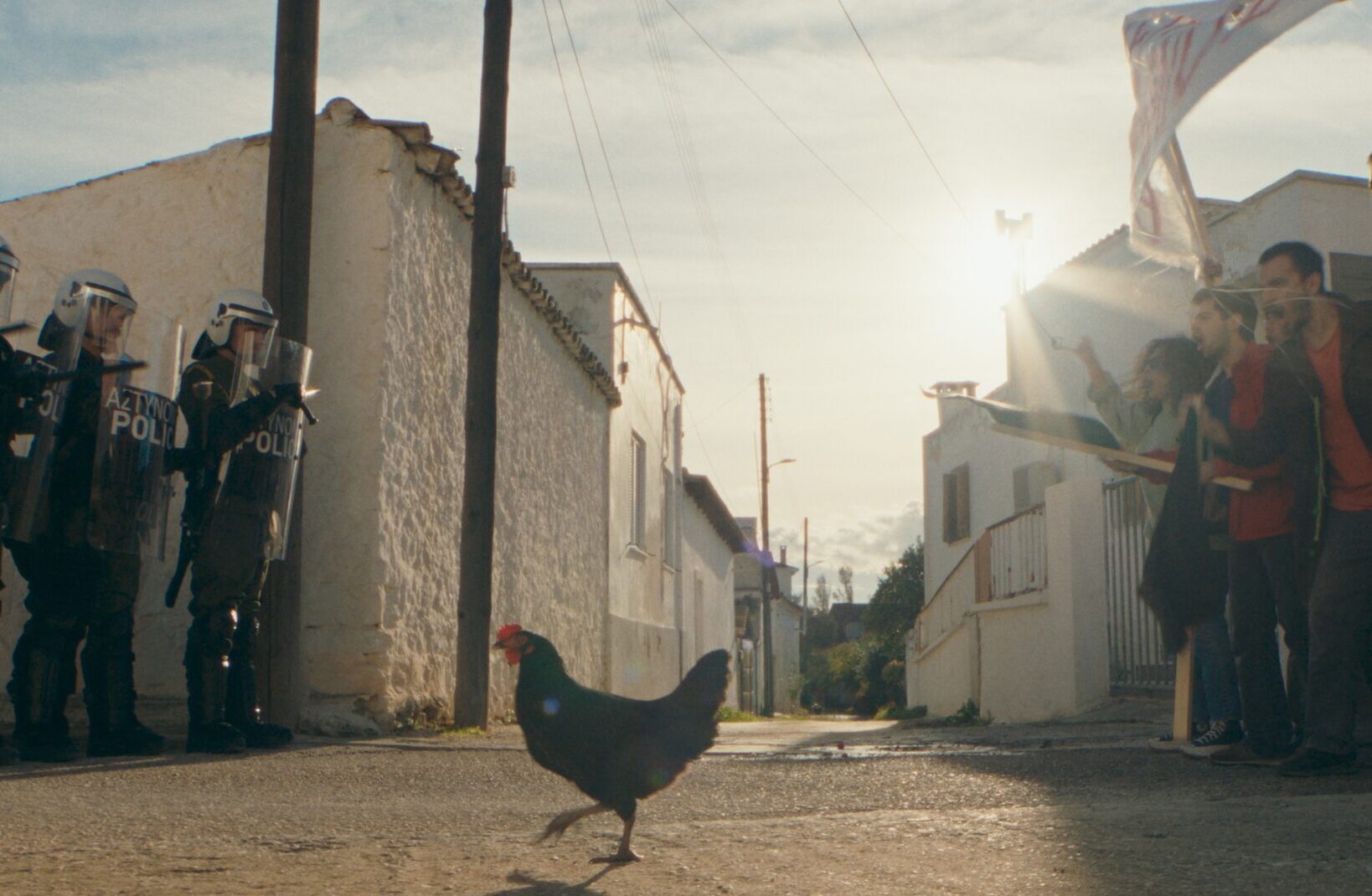
In the beginning was the hen that laid the egg. Hen is a film about a chicken, humans, and relationships. The film follows a chicken’s accidental escape from a factory farm to the countryside.
The film’s protagonist is a dark chicken. In reality, there are eight main actors: Eszti, Szandi, Feri, Enci, Eti, Eniko, Nora, and Anett. The chickens were trained to perform a variety of tasks, and it is not easy for the viewer to tell when the lead performer changes.
When it is revealed in the film’s credits that no animals were harmed in the making of this film, a human is filled with a sense of relief. They are free to feel a range of emotions, safe in the knowledge that all is “actually” fine. That the chicken that was lifted from its wing was not hurt. That it did not actually suffer any fire burns. That the trained fox actor did not suffer when it was run over by a car. That the battery farm, in which the beak-trimmed chickens lived their lives in cramped conditions behind a barbed wire fence, panting for breath, did not actually exist. What a relief!
But outside the film, we inhabit a world and a reality in which animals are harmed every day in food production and fur farming. Laying hens, which are shown in cages at the beginning of the film, suffer when they are bred into egg-producing machines. Cockerels, unnecessary for egg production, are directed to be shredded alive or to a carbon dioxide chamber to die. Broilers, of which we get a glimpse at the beginning of the film, suffer from leg pain and other issues caused by growing too fast through their five-week-long, boring lives.
Is it possible to make a film from the perspective of an animal?
Is the film able to portray the story from the perspective of the chicken? Is filming from low on the ground and following the action from the chicken’s point of view enough for the film to be from the chicken’s perspective, or will the perspective inevitably be that of a human who is trying to imagine what the chicken’s perspective might be like?
After all, we are talking about a film, ineluctably a story told by humans to other humans. The film is about relationships between species and about control, but most of all it is about humans themselves – and the assumption is that the viewer is a human being. Through the chicken’s tale we get a glimpse of human family relationships as well as the trafficking of migrants, even if our gaze is firmly on the protagonist, the chicken. The humans are agents, but in the background. There is a desire to show the viewer that humans are capable of indifferent and cruel behaviour towards others, regardless of whether that other is a chicken, a dog, or another human being. Human actions have an effect on other beings even if humans don’t realise this.
What makes this story occasionally uncomfortable to follow is the anthropocentrism that seeps through the chicken’s story. The chicken falls in love with roosters, like a human being hoping for a heterosexual relationship through falling in love at first sight. Chickens protect the eggs they lay like a mother filled with worry who protects their unborn child, but the film’s hen does not seem to have a broody instinct. The chicken is an individual, a lonely hero, without the vital support of a flock, even though hens normally rely heavily on their flock. To anthropomorphise animals is not wrong as such, but it can be misleading – and it highlights qualities deemed praiseworthy from a human point of view.
The implausibility of the chicken’s point of view is enhanced by the fact that time after time the protagonist seems to seek to go on walks inside human buildings. While domesticated, well-treated and brave individual hens might be inclined to walk through open doors into human dwellings, why would a chicken on the run, who has encountered rough-handed humans, choose to go into built environments and indoor spaces, when her other option is to escape farther? The hen also follows human conversations and actions with special attentiveness.
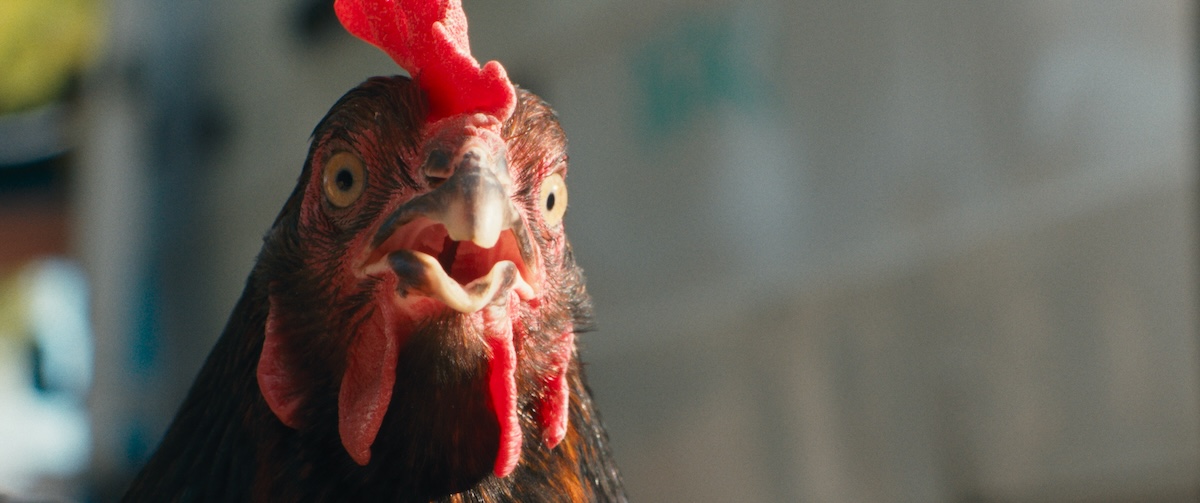
Absent from the film are some species-typical behaviours such as scratching, bathing, and pooing. Chickens spent large portions of each day scratching the ground, looking for food. They also bathe in groups. Both actions are calm and relaxing to watch. As they are absent from the film, there is a constant tension and a sense of unpredictability in the film. When the protagonist gets locked into a pen of turkens, she gets into altercations and is trampled by a rooster, and shooed by a human boot. At no point do we witness a calm group scratching or bathing session. A hen as the protagonist is apt to appeal to our sense of empathy, but how large a portion of this empathy is rooted in identifying with the anthropomorphised aspects of the animal?
Despite the restless and tense atmosphere of the film, the tale seems to come to a happy end. It is possible to write a happy ending to a film, but not to reality. Mother hens do not get to see their chicks or to learn new skills from their fellow creatures.
Is the use of animals in films an issue?
An animal as the protagonist of a film is not unheard of. However, the use of animals in films will always present several questions, such as how the animal was treated before filming and how was the animal taught the skills required for the film? How were they treated during the filming process? What happened to them after filming? It’s difficult to find answers to these questions. Usually the only available information is the disclaimer at the end of the film: no animals were harmed during the making of this film. That is the case for this film, as well.
After some research, we were able to find interviews conducted with the person who trained the chickens for this film. In charge of the process was a professional animal trainer, who runs a farm of over 300 animals in Hungary. Their primary occupation is to train animals and other trainers for the purposes of the film industry.
From the interviews, we learned that 15 dark chickens were originally acquired for the making of this film. The filming took place in Greece, and of these 15 chickens, 8 were transported there. However, the total number of chickens was higher: it was the trainer’s wish that the chickens trained for this film only had positive interactions with humans. Therefore, they bought more dark chickens in Greece to be used in scenes which the chickens most likely found uncomfortable, such as when the chicken was forcefully apprehended, it was lifted by its wing, or when it needed to act wounded.
In the end, there were two classes of protagonists.
Finland’s 90 million chickens
The broiler is Finland’s most common bird. Further, broilers and chickens are our most numerous farm animals. In spite of this, we know very little about them, and public discourse about chickens is almost non-existent.
Each year, approximately 85 million broilers are killed in our farms and in slaughterhouses. Additionally, some 4.6 million laying hens live in our country every year, and approximately 2 million newly hatched cockerels are killed. Overall, therefore, some 90 million domestic chickens live amongst us, but how many live chickens will an average Finn encounter during one year? Our guess is that the number, on average, is zero.
The few opportunities for encountering chickens are at backyard chicken coops, domestic animal yards, and animal sanctuaries. These provide opportunities for the average person to see how individual chickens are, and how multi-faceted and interesting their behaviour is. These encounters tell us about chickens as individuals, but they hide the reality of where the broiler products and eggs at the supermarket come from.
Today, chickens exist almost solely for the purposes of the livestock industry, and they spend their days in cramped and barren halls, surrounded by tens of thousands of other chickens. All broilers live in halls, but some laying hens still live in cages.
Broiler production in Finland is almost exclusively industrially scaled, with chicks born weighing just 40 grams growing in just five weeks into birds ready for slaughter at 2.4 kilos. They wouldn’t be able to live much longer anyway, as pain and difficulty moving make their lives almost impossible at a very young age. The halls are cramped: on one square meter it is possible to raise over 16 broilers, meaning that one bird has approximately one A4-paper’s worth of space to move around.
Laying hens live approximately one and a half years in egg production, but that is hardly a good life. Conditions are cramped, regardless of whether we are talking about so-called furnished cages or floor-based systems. Only organic hens and hens kept in free-range systems have access to the outdoors. Aside from cramped conditions, laying hens also suffer from diseases caused by the intensive rate of egg production.
Hen is a narrative film about a chicken, and it is sure to raise empathy and interest towards chickens. Hopefully, due to the work of its protagonists, more people will leave broiler products and eggs on the shelf at the supermarket – if this is the case, the movie has served its purpose from the chickens’ point of view. Each chicken deserves to be seen as an individual, not a worthless cog in the fast-spinning machine of the livestock industry.
Tiina Ollila & Laura Ollila
This article is published with the animal rights organization Animalia.