Helsinki International Film Festival is a celebration of cinema and the community around it. HIFF prides itself on always bringing fresh and unique perspectives, not only in film but also in how it approaches organising a festival and an international event.
As the largest film festival in Finland, HIFF is committed to continuously working on improving its actions linked to sustainability. One of our ambitions is to always perform better. We are committed to creating a more equitable and ecologically sustainable film industry.
Good Travel Seal
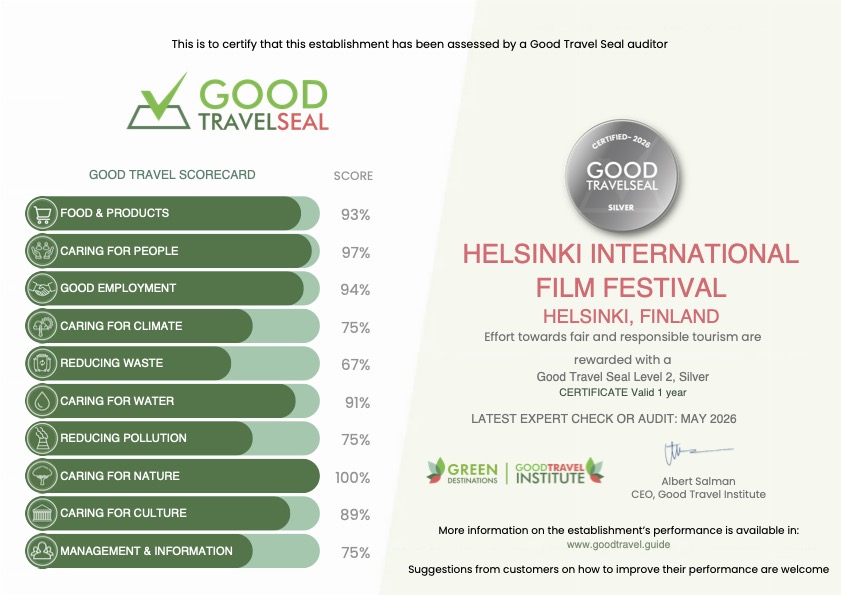
In April 2025, HIFF was awarded both the Good Travel Seal (level 3). The Good Travel Seal (GTS) is an independent sustainability certification for tourism businesses, designed to help businesses communicate their environmental and social performance credibly, transparently, and in line with European regulatory expectations.
The Good Travel Seal recognised the festival’s work as well as improvement plan in the following topics:
- Food & Products
- Reducing Pollution
- Caring for People
- Caring for Water
- Good Employment
- Caring for Nature
- Caring for Climate
- Caring for Culture
- Reducing Waste
- Management & Info
Sustainable Travel Finland Label
For the Sustainable Travel Finland Label, HIFF has undergone a 7-step sustainable tourism development path. Each step is accompanied by criteria that comply with international standards. After completing the entire programme, HIFF was recognized with the Sustainable Travel Finland Label. The label is a definitive symbol of commitment towards sustainable practices and principles.
The STF label is renewed regularly.
Our main goals for sustainability
As a guiding framework for its future actions, HIFF commits to following ISO 20121, an international standard for sustainable event management. Furthermore, our practical goals are based on the UN Sustainable Development Goals.
Since 2026, HIFF has a named team member dedicated to focusing on the advancement of the festival’s environmental, social, and governance (ESG) related issues, with a particular emphasis on sustainability and accessibility, as well as diversity and inclusion.
What was done in 2025:
- Implement recycling stations at main festival venues to further improve waste management
- Anti-harassment training for our staff
- Improving internal processes to handle workplace harassment and conflict cases more efficiently and transparently.
- Making festival prices more inclusive by enabling online sale for specific customer groups (seniors, job seekers and students)
What we are working on for 2026-2027:
- Establishing an official Sustainable Policy to further guide our team on sustainability actions and purchasing decisions
- Providing First Aid & Security Training for year-round employees
- Planning to involve our theatre supervisors (volunteers) more closely in the development and refinement of our safety protocols, as they are often the first to respond in potential threat situations
Currently working on:
- Calculating the festival’s entire carbon footprint for year 2026 (and continuing to track our emissions in the future)
- Change to a renewable energy provider for our office premises
- Improving energy efficiency in the festival venues
We have made a calculation of the carbon emissions caused by HIFF’s guests’ travels in 2025, and it stands at about 51.36 tonnes.
That confirmed that the emissions due to international travelling of HIFF guests is our biggest challenge, as doing HIFF without them would not be possible. Being a non-profit organisation, HIFF cannot compensate financially for those flights. What we can do instead – and what we are already doing – is prioritise booking exclusively direct flights whenever possible, offer land travel connections whenever possible, provide guests with an HSL (public transportation) card, and overall keep on improving in all means possible.