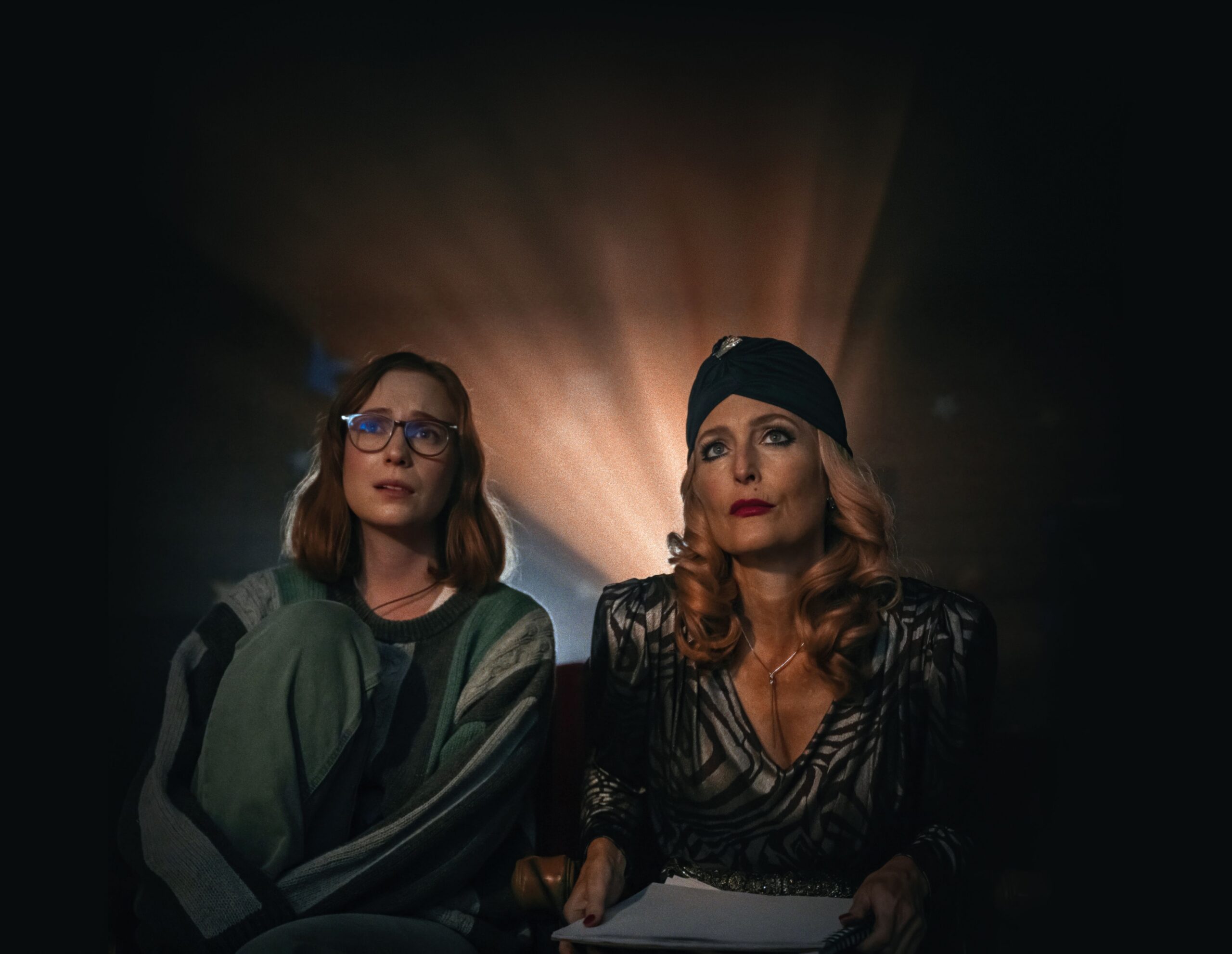
Sometimes — especially after a film experienced in a theater — the world, the city lights, the wind on your face, riding your old bicycle, or hovering on the threshold of sleep in the darkness of a studio apartment can suddenly feel new, different. There are imperceptible forces in the world to which cinema can once again make us susceptible. The Adams family’s Mother of Flies, Eduardo Casanova’s Silencio, and Jane Schoenbrun’s Teenage Sex and Death at Camp Miasma are all films about going elsewhere, surrendering to the unknown, yet palpable, forces when the numbing futility of repetition, convention, and the explainable becomes too constricting. One surrenders to witchcraft, feeling, death, and cinema.
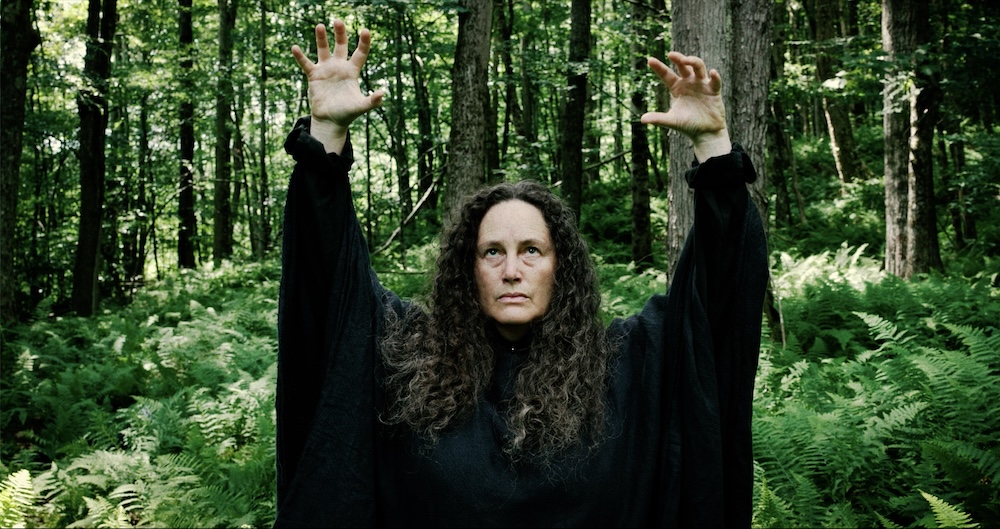
In Mother of Flies, Mickey has been unable to receive effective treatment for her cancer through medically explicable means, so she tries to find help somewhere on the border between the real and the unreal. Together with her father, she visits Solvig, a healer who lives in seclusion. Solvig is one with nature—especially flies—like someone from the past, yet here and now.
In Silencio, a vampire family lives through the eras of the Black Death and the HIV epidemic. In the fourteenth century, one of the siblings, Veronica, has fallen in love with a human man and wants to live as a human, but this plan, so to speak, falls through. At the turn of the 1990’s, Veronica’s daughter Malva wants to move closer to the human world in all its tactility. She wants to abandon the vampires’ principles and surrender to the supposedly dangerous outside world, daylight, human-like life, and the unknown of feeling.
In Teenage Sex and Death at Camp Miasma, filmmaker Kris Williams visits Billy Presley, the former star of the Camp Miasma slasher franchise, at the location where the first films in the series were shot. Kris has become estranged from themself and from embodied, holistic feeling, having buried themself beneath a compulsive analysis of the morality of films, the world, and the representations and symbolisms of their own desires. Yet while spending time with Billy, Kris surrenders to their own “problematic” desires — and to the power of cinema.
Cinema does not happen only on the screen. It is not merely images that point toward something outside themselves; it is not merely symbolism or representation. One can also surrender to cinema’s unknown but palpable forces. To live is to feel. Is a film a moving image if you do not let it move you?
“Inside, outside. Full, empty. Safe, toxic. …” Philosopher Paul B. Preciado’s mantra-like book Dysphoria Mundi is like a tangled skein unraveled, in which dichotomies and categorical boundaries twist into something strange. Preciado writes about many things, including the similarities between the COVID-19 pandemic and the HIV epidemic, and how the viral era of the 2020s can destabilize Western society. The COVID-19 pandemic has enabled the accelerating escalation of the surveillance society into a “petrosexoracial” and “necrocapitalist” system cutting across the real and the virtual. Preciado conceptualizes the social transformation of the 2020s, the accelerating fascism, the sensation of constriction it produces in the body — like lockdown—and the resulting desire for another kind of world as a revolutionary force, “world dysphoria” (dysphoria mundi).
Throughout the book, Preciado repeats a litany of binary categories: “… Male, female. White, Black. Domestic, foreign. Culture, nature. Human, animal. Public, private. Organic, mechanical. Centre, periphery. …” With every repetition, the power of the dichotomies appears more precarious. Eventually, as a reader, I do not even bother reading the string of dichotomies — the more interesting question is how the dichotomies falter, how life, the body, the senses, sex, surveillance, truth, and so on are “out of joint.” In this text, cinema is out of joint.
“… Here, there. Analog, digital. Living, dead.” A stream of images, a stream of bodily fluids, flesh, cinema. Categorical boundaries waver, cinema merges with the body, streams of bodily fluids merge with streams of images; there is no screen between us, the borders are porous and leaking, a warm organ squeezes out a new film in which I am you, and you are me. Killer, killed. Here, there. Living, dead. Film, viewer, filmmaker, experiencer. In Camp Miasma, Mother of Flies, and Silencio, the films reach into the spaces between boundaries, splitting them open like the surface of skin, opening an organ from which something new gushes forth.
Do you watch a film from outside it, or are you inside it? Flies crawl against the window, and they crawl on your skin. I cover my shins so that the images of Mother of Flies will not get too close to my skin. But the film’s peculiar atmosphere and its swarming, rustling images get inside me anyway. The boundaries between life and death, the real and the unreal, waver: Solvig is and is not; she belongs to a time past and to the present. The father’s mouth is full of fly larvae, but perhaps it wasn’t. A dead breast is a thistle—no, it was only a cut, but the cut left no wound. “We believe.”
Something that seems like a dream can also affect the real. One can cross over boundaries.
Fluids and flesh. Fluids and flesh and illness. Inside, outside. Sick, healthy, immune, susceptible. Disease, illness, human, other, plague, HIV, silence, death. Infected, infecting. Past, future, present, present. Vampire, human. A needle pierces the surface of skin/the screen. It passes through the interface between categories, pushes the outside in and brings the inside out. Blood, poison, drug, virus, medicine, sensation, feeling, truth. Who is human, who is innocent, who is immune?
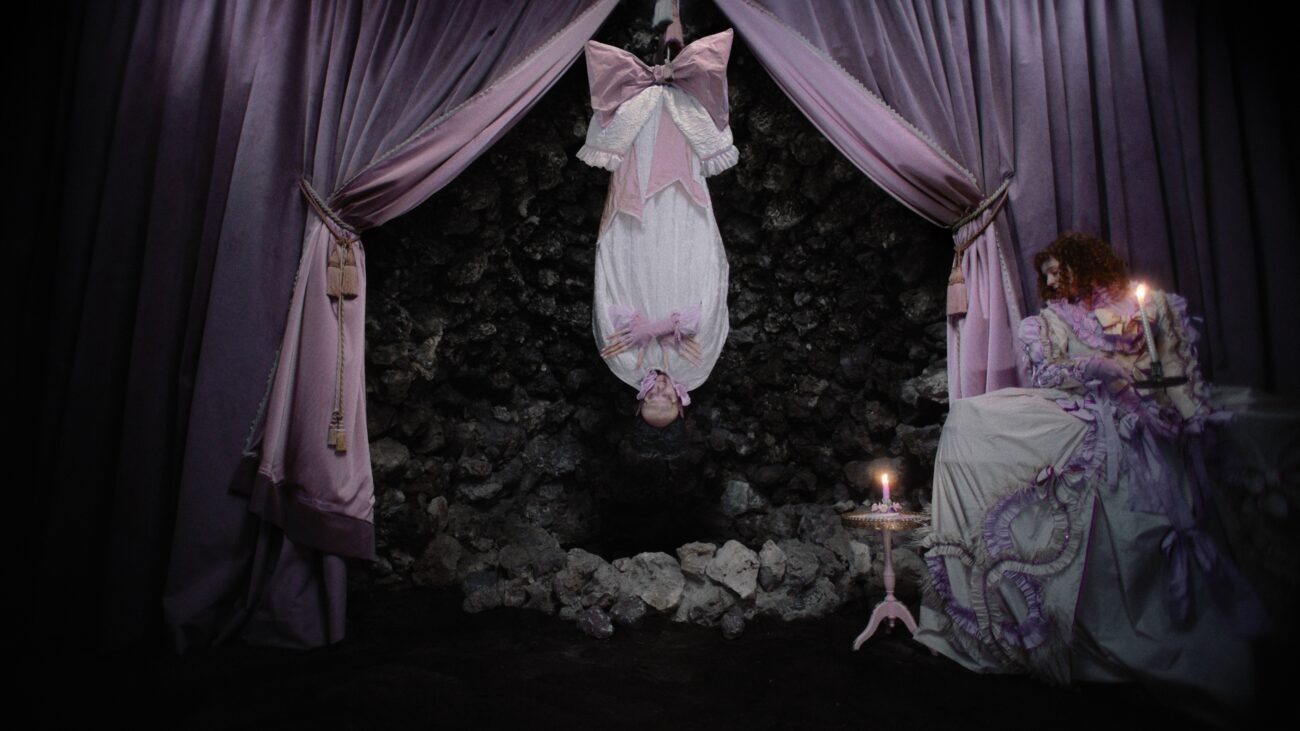
In Silencio, the past becomes mixed with the present; blood splatters wildly in a musical moment at the boundary between eras, causing the forces of cinema to rise onto the screen in a particularly powerful way. Human and nonhuman bodies become entwined. Only one is in the image, only one can be represented on film, only one feels, yet the other can also surrender to feeling. Feeling is not a disease. Who infects whom? Perhaps it was all only a dream, and Diego Serrano rises once again. But something that seems like a dream can also be true.
In Camp Miasma, Little Death rises once again from the bottom of the lake to kill, and it is not a dream, it is not symbolism, not a metaphor, nor a representation. It is not a film, yet it is precisely cinema: the truest of truths, but perhaps still only play. As in Jane Schoenbrun’s earlier films, Camp Miasma centers on the obscurity of the boundary between the real and the virtual. In We’re All Going to the World’s Fair, the internet reaches into a teenager’s attic bedroom, and the teenager disappears into the internet: the wavering of reality feels threatening, strange. In I Saw the TV Glow, the real self does not exist in the real world but elsewhere, and the real world squeezes reality into an ever narrower space until it bursts; the body in which reality lives cracks under the pressure between external and internal forces.
Schoenbrun’s films could, for example, be conceptualized as metaphors for transition, but what is most affecting about them for me is how they feel. They operate through intensities that remain outside or at the margins of representation, intensities that push through me. They leave something inside me and set something suffocating inside me into motion, pulling it loose — algae from the surface of a spear, heavy metallic blood out of the chest. The cinematic experience leaves a mark on the body.
Especially in Camp Miasma, there is a move away from the hegemony of representation: in the film, cinema is not the sum of representations and symbolism. It simply is. It is not a moving image but a lived image, a cluster of intensities of experience. The real is not behind a veil; it is here and now, here and there, then and now and always and never. You are not immune to representation or to the lure of the safe distance offered by the gaze. By crashing the real and the virtual into one another, Camp Miasma places the viewer in a state of susceptibility in which cinema can come close to the body. It becomes unclear where the film ends, and the other begins, not to mention reality. Who is watching? Who is being watched? Cinema is out of joint. The viewer is out of joint. Identification is out of joint.
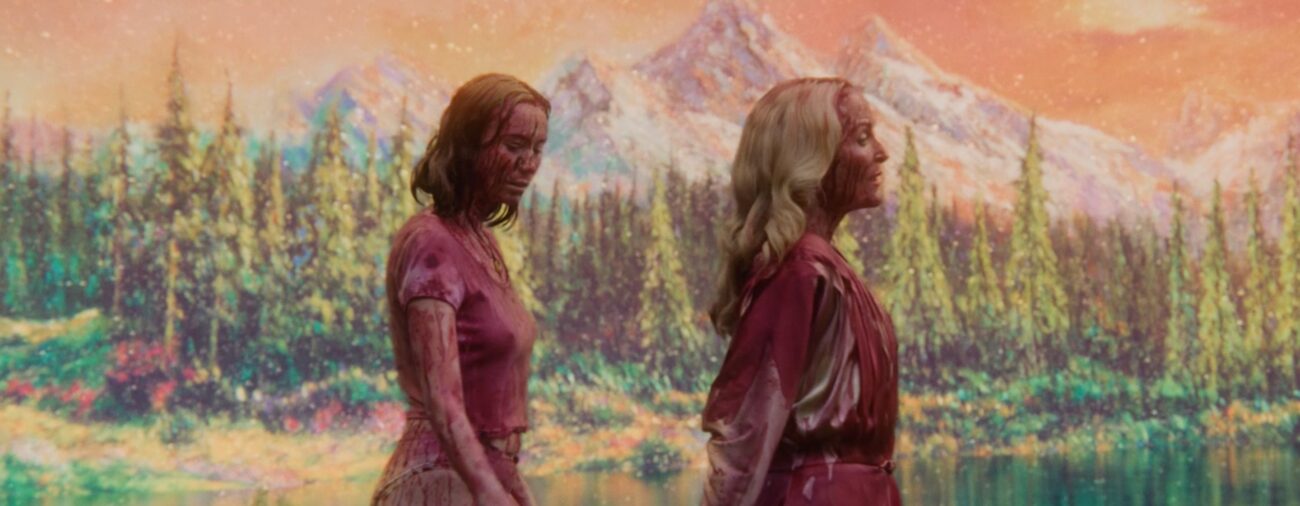
The surface of the body, the viscera. Upper body, lower body. Little Death cuts apart and separates things that define one another through their opposition: viewer, viewed; pursuer, pursued; killer, killed. They can be sewn tightly back together; the upper lip can be sewn to the lower lip. The needle relentlessly forces its way around the lips—over, through, through, over, through, through. The stitches close off and silence the threatening, dangerous, defiant space revealed by separating the opposites from one another. Silence = death. Resistance cannot burst into motion from between the sewn-shut dichotomies.
But Camp Miasma is also the pure joy of cinema, a fireworks display of blood. In fact, it is not about splitting dichotomies apart (although people are certainly split apart in the process), but about crashing them into one another through a planetary gravitational force that crushes their elements into one another. The outside does not remain outside—nor does the inside turn outward—but instead they form a new entity in which there are no boundaries between inside and outside, only gaps. Through these gaps left between representations, cinema acts and feels with its wordless force, and there is knowledge in the sensations. Let the film thrust itself inside you like a spear rising from the lake. Let the inside seep outward. Die a little, come alive. It is not too late; dysphoria mundi.
Usva Sylvia Saloheimo
The writer is a soon-to-be Master of Film Studies, who writes about cinema from the liminal post-studies state, in which the past, the present, and the future all seem equally vague, difficult to put into words, yet feel slightly unsettling in the body.
References
Films
I Saw the TV Glow. Directed by Jane Schoenbrun. 2024; USA; Fruit Tree / A24. 100 min.
Mother of Flies. Directed by John Adams, Toby Poser ja Zelda Adams. 2025; USA; Wonder Wheel Productions / Shudder. 92 min.
Silence (Silencio). Directed by Eduardo Casanova. 2025; Spain; Gamera Studios / Aboyo Positivo. 58 min.
Teenage Sex and Death at Camp Miasma. Directed by Jane Schoenbrun. 2026; USA; Plan B / Mubi. 112 min.
We’re All Going to the World’s Fair. Directed by Jane Schoenbrun. 2021; USA; Dweck Productions / Utopia. 86 min.
Literature
Ahmed, Sara. 2018. Tunteiden kulttuuripolitiikka, translated by Elina Halttunen-Riikonen. Niin & Näin.
Herzog, Amy. 2010. Dreams of Difference, Songs of the Same: The Musical Moment in Film. University of Minnesota Press.
Hongisto, Ilona and Kaisa Kurikka. 2016. “Esipuhe: Muuri ja murros.” In Toisin sanoin. Taiteentutkimusta representaation jälkeen, toim. Ilona Hongisto and Kaisa Kurikka, 7–18. Eetos.
Marks, Laura U. 2000. Skin of the Film: Intercultural Cinema, Embodiment and the Senses. Duke University Press.
Preciado, Paul B. 2025. Dysphoria Mundi: A Diary of Planetary Transition. Fitzcarraldo Editions.
The Conspiratorial Association for the Advancement of Cultural Degeneracy. 2021. ”A Dialogue on Deleuze and Gender Difference.” InTransgender Marxism, edited by Jules Joanne Gleeson and Elle O’Rourke, 200–3. Pluto Press.