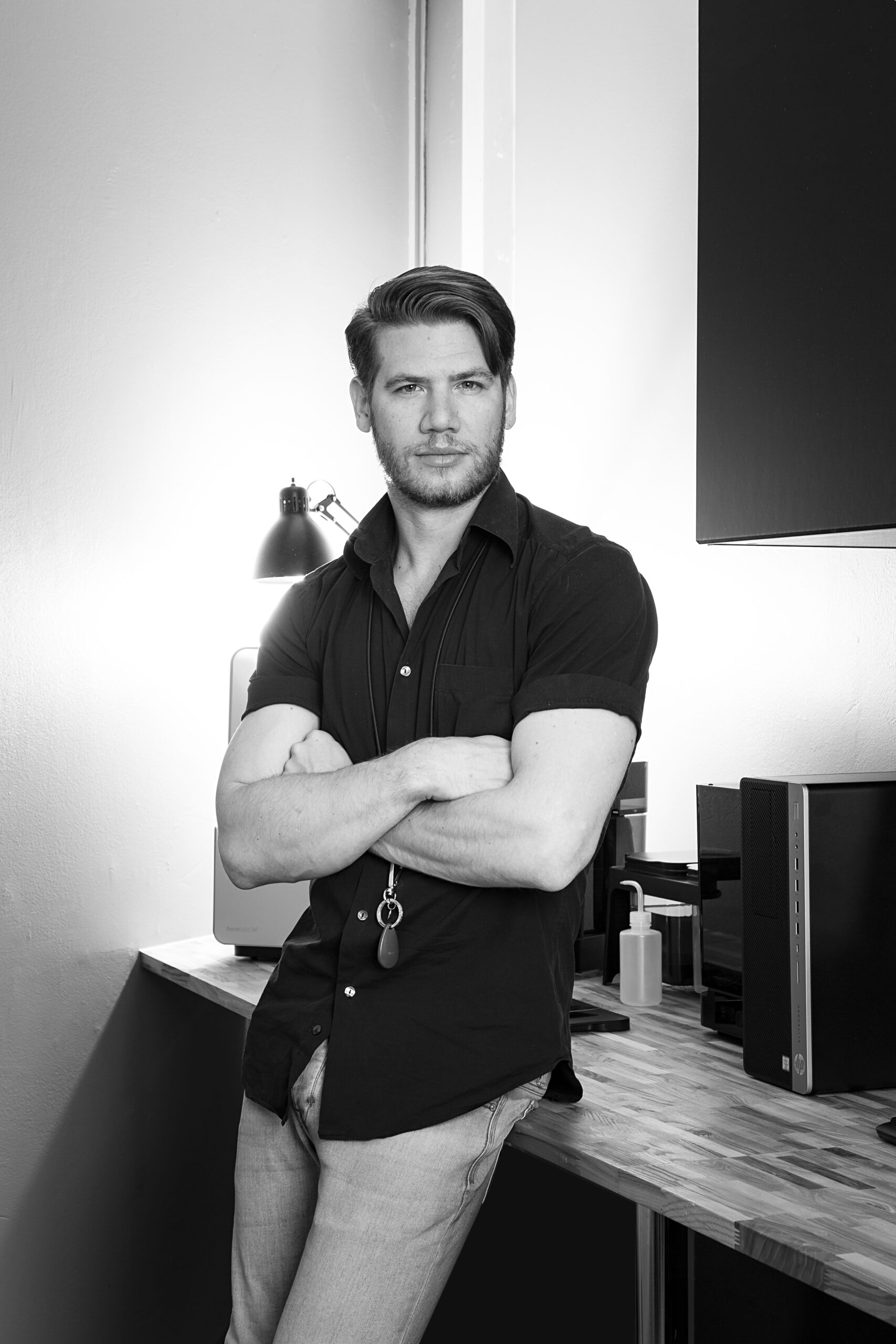
If one asks ChatGPT the leading question of, ‘Is AI useful for filmmaking?,’ the answer is: “Yes, AI enhances filmmaking through improved script analysis, virtual production, automated cinematography, and real-time visual effects”. However, if one asks multifaceted creative Umberto Onza the same question, the answer is far more enthusiastic, and sophisticated.
From 20-22 September, Onza will lead the second edition of the Söderlångvik Masterclass, where 12 Nordic film professionals will enter a 3-day retreat dedicated to exploring AI in filmmaking. An internationally renowned Design Director, Onza specialises in product design, generative AI, and innovative brand experiences. Beyond his formal working titles, Umberto Onza is a creative whose career path has been redefined by embracing uncertainty. His own story with AI most likely resonates with many other creatives.
Before experimenting with generative AI, Onza had a decade or more behind as a design professional. How did his journey end up in AI?
Umberto Onza: As a creative, my weakest creative skill has always been writing. Translating my ideas into text feels hard, not to mention writing scripts. When the first LLM (Large Language Model) came out to OpenAI in 2022, ChatGPT 3.5, I tried it out of curiosity.
I have worked at TBWA’s Helsinki unit –an award-winning creative agency known for its disruptive approach to innovative advertising and brand experience– for ten and a half years; my background is in Industrial Design and Design Management. After many years in the creative field, you get a continuous itch to try new paths, so I first experimented with something as simple as writing a few prompts.
And it blew my mind.
It suggested powerful and brilliant sentences, but above all, it felt way more efficient than what I could be. It took seconds to generate incredible ideas, and as I went further, a short script, a story. And yet my next thought, a second later, was: one day, will this tool take my job and replace me? I was somewhat afraid but also curious, and this made me go down the rabbit hole. AI is not only about writing text or brainstorming ideas; I can create images, and those images could in turn be moving pictures. Instead of writing a paper, sketching or visualising my ideas, I could do a case video of the ideas I wanted to present.
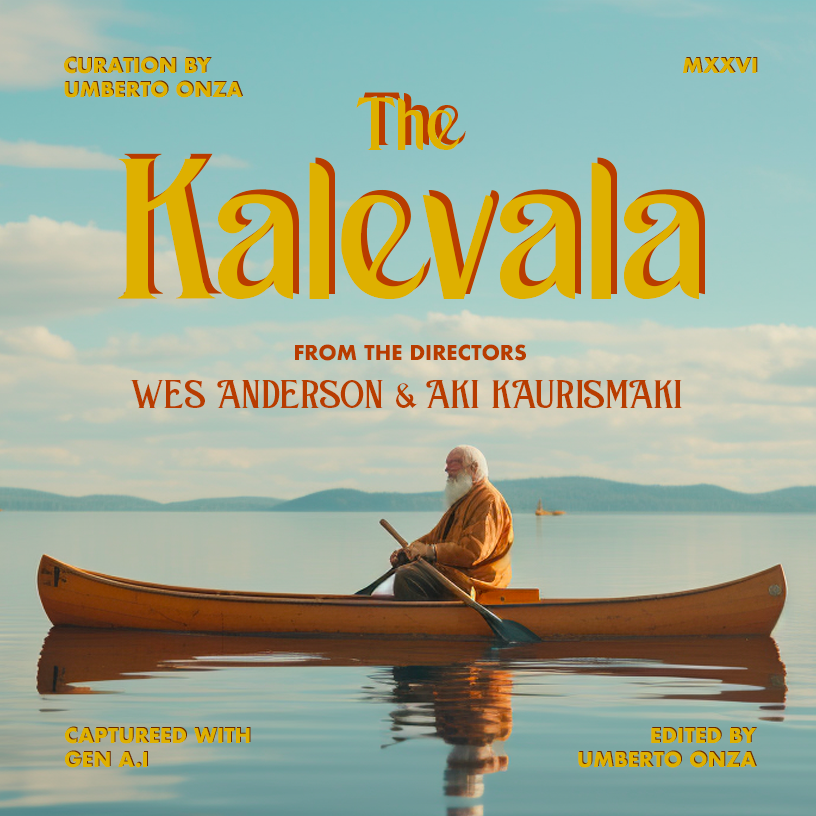
From trying out prompts to creating his interpretation of the Kalevala, Onza underwent a significant learning process. Having previously mastered graphic platforms in his job –Photoshop, Illustrator– he veered now towards animation: Adobe After Effects, and Adobe Premiere. Onza’s Kalevala will be ready in mid-August, but for the time being, the trailer is hypnotic, beautiful, and surreal at the same time.
UO: Equipped with video-making knowledge, just out of curiosity I created a fragrance ad with AI in a day and immediately realised I wanted to work on a proper trailer. The idea for Kalevala came from my admiration towards Wes Anderson and Aki Kaurismäki. They both have unique, sharp, styles and, at the same time, I have been attracted to their similarities. Creating the Kalevala was an exercise of creativity for me: what would a collaboration between them look like? It took me around 10 days to complete the trailer, and I was so satisfied with the result that I tried another one, Bolognese di Dante, which took even less to finalise. This is just the beginning, as I am currently developing several other videos. Both of these videos were created a year ago, and the technology has advanced lightyears since then which makes AI even more usable for production purposes.
The fear Onza mentions is natural to many other creatives. After all, job displacement is an important concern in the creative industry. Onza, however, chose not to reject AI or be paralyzed by it. Instead, he transformed his fear into possibility. How can one be comfortable with AI being part of the creative process?
UO: You get comfortable by repeatedly implementing AI in your workflow; even in your everyday life. Thinking about AI as your personal assistant, which you use as part of the creative process, is understanding how you, specifically you, can utilise it. We are all unique individuals with different habits, different morning routines, and different lived experiences. All this makes the use of AI highly individual.
When you see how much AI can help you come up with ideas that would not necessarily have come to mind or free up time, there’s also less fear. In the world of advertising, video and filmmaking can take a lot of time. In Industrial Design, designing a plastic chair can take a year or more of work. Then, suddenly, you have AI that helps you conduct extensive research, market studies, sketch, visualise your ideas, 3D model, and even test your idea or concept. Your only task is to validate: say good, not good, yes, no, and ask it to make adjustments. When you understand the freedom it gives you to keep creating and concentrate on the work you do best, using AI becomes rather empowering.
Efficiency and creativity are the golden words in AI nowadays, and rightly so. How can a creative professional compatibilise this efficiency with artistic risk?
UO: In creativity, there is the business side and art as a form of individual expression. Artists might not always need to focus on efficiency. They can use AI to be more explorative and creative. We enhance our creativity in many ways, such as surrounding ourselves with like-minded creative people, observing, and exposing ourselves to creative experiences like coworkers, friends, art exhibitions. AI provides a new set of possibilities to help bring ideas to life, test, and explore.
On the business side, in fields like film production, design or advertising, you have goals to execute and need to pitch and sell ideas to clients, which makes efficiency crucial. Efficiency is reshaping the advertising field: AI is increasingly implemented in the workflow. For example, creating a TV ad no longer requires renting expensive equipment or outsourcing work; now teams can work more centrally and internally using AI tools, reducing logistics, time, and expenses. If we can execute tasks in three hours instead of seven, we can take on more projects and focus on delivering even more high-quality work.
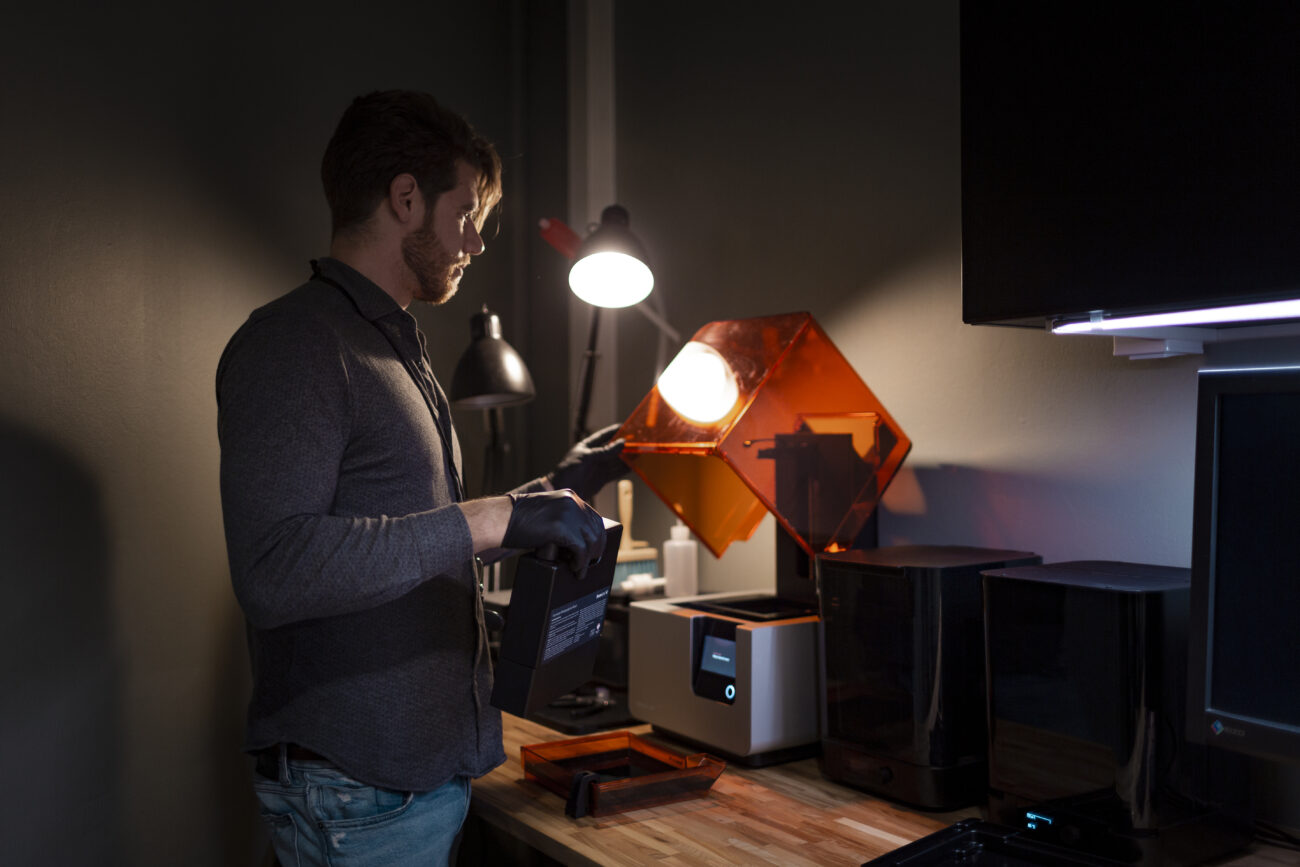
At the Söderlångvik Masterclass, Onza will guide film industry professionals to enhance their creativity with the efficiency AI brings to the process. Speaking strictly about filmmaking, what is the biggest use of AI in film production?
UO: Soon production companies can rely on AI to handle film production internally. Even a movie director can create a whole film by themselves. AI contributes to creative professionals mixing roles, which leads to smaller teams being created, and allows companies to produce films as well, so not much public financing might be required. And yet, you still need to have a playful plot, a good script, and elevated craft that requires human validation skills. A great craft is the key to everything.
At the Söderlångvik Masterclass we’re addressing one of the biggest trends in AI at the moment, making the weekend incredibly relevant: using AI to generate a script that is turned into text prompts, which are then turned into images and videos. video from images, and videos from text. Especially with Luma Dream machine and Runway Gen-3, you can generate incredibly high-quality video scenes that are eventually edited into a full movie clip. Many are waiting for tools like OpenAI Sora to be released, but we already have access to similar amazing tools that do the same and allow us to explore and be creative together.
Reinventing oneself constantly seems key in AI times, including for professionals in the film industry. Onza himself says that the intervention of AI redefined his career path completely. At his work company, TBWA, he educates designers, marketers, and strategists on how to use AI efficiently and in practice, how AI bots are trained and how marketers can use it to make better decisions. With so many possibilities, what are the challenges for creatives when using AI?
UO: Technical expertise is usually perceived as an obstacle when it comes to AI. However, there are various levels of expertise out there. To begin experimenting does not require that much; on the contrary, it is quite accessible. What I do see, though, is a substantial increase in AI-generated content, precisely due to its easy access. My psychotherapist mom can start creating videos with AI if she so feels like. Like her, many others with little to no experience in video making can do the same. This makes it harder to spot the good craft: if there’s so much of everything, how do you highlight your skills? Quality is key, so how do you separate yourself?
In this context, what kind skills are needed in order to maintain this good craft and stay competitive with AI?
UO: Good validation skills, problem-solving abilities, and a comprehensive worldview. How you perceive your surroundings will define how you utilise AI. Our worldview informs how we validate AI, the paths you take when using it, the designs you create, and the solutions you develop.
Knowledge of platforms that are not AI –3D animation or CAD software, all Adobe’s Software– is also valuable, yet soon AI will be integrated into all these creative software. For instance, soon we will be able to write a prompt in a 3D animation program, which will generate a fill object with textures and illuminations. This would mean we won’t need to do the conventional 3D modeling process anymore that usually takes a lot of time. AI will eventually be so ingrained in our everyday technology –our phones, for example– that we won’t even notice we’re using it. The skill set that doesn’t change, however, is the one that comes from within, which in turn is the most powerful.
The conversation draws to a close. Behind Onza stands a beautiful, triangularly shaped wooden cabin, one of his many creative projects. ‘Today I will be working on the floors,’ he smiles. His creativity stretches far, and possibilities are plenty. What does the near future hold for AI, in his opinion?
When we talk about using AI as we will be using it, one aspect to be aware of is its ethical side – how biased it is, and why: it’s biased because we are biased. Discrimination, cyber security, ethics in data usage. This side is a completely different, long conversation. As individual users, and as professionals, we must have these open discussions, not only with others but also with ourselves, so we can use AI in the most responsible way.
The near future has many fronts open, yet a magnificent one is the creation of AI assistants to handle tasks. I have created several bots to automate parts of my work. This is the next level: creating personalised assistants that help you do your work. Imagine a world where from the moment you wake up, your task is just to validate your bot’s responses: you have assistance with your admin work, you even request a 15-second video that a client has just requested, you just ask for adjustments as you need. Might sound too simple, but this will be the reality.
AI is already asking the question: what is the future of human work on both practical and philosophical levels? It will change our society drastically. Most likely, AI will unfortunately decrease work opportunities for some but, at the same time, create new jobs and roles while making traditional professions more diverse. This will likely lead to universal basic income and a shift in how we perceive work. AI can automate many tasks, allowing us to focus on the things that interest us or where we excel. This transition means that we can rely less on specialized skills for basic tasks, making our professional lives more fulfilling.