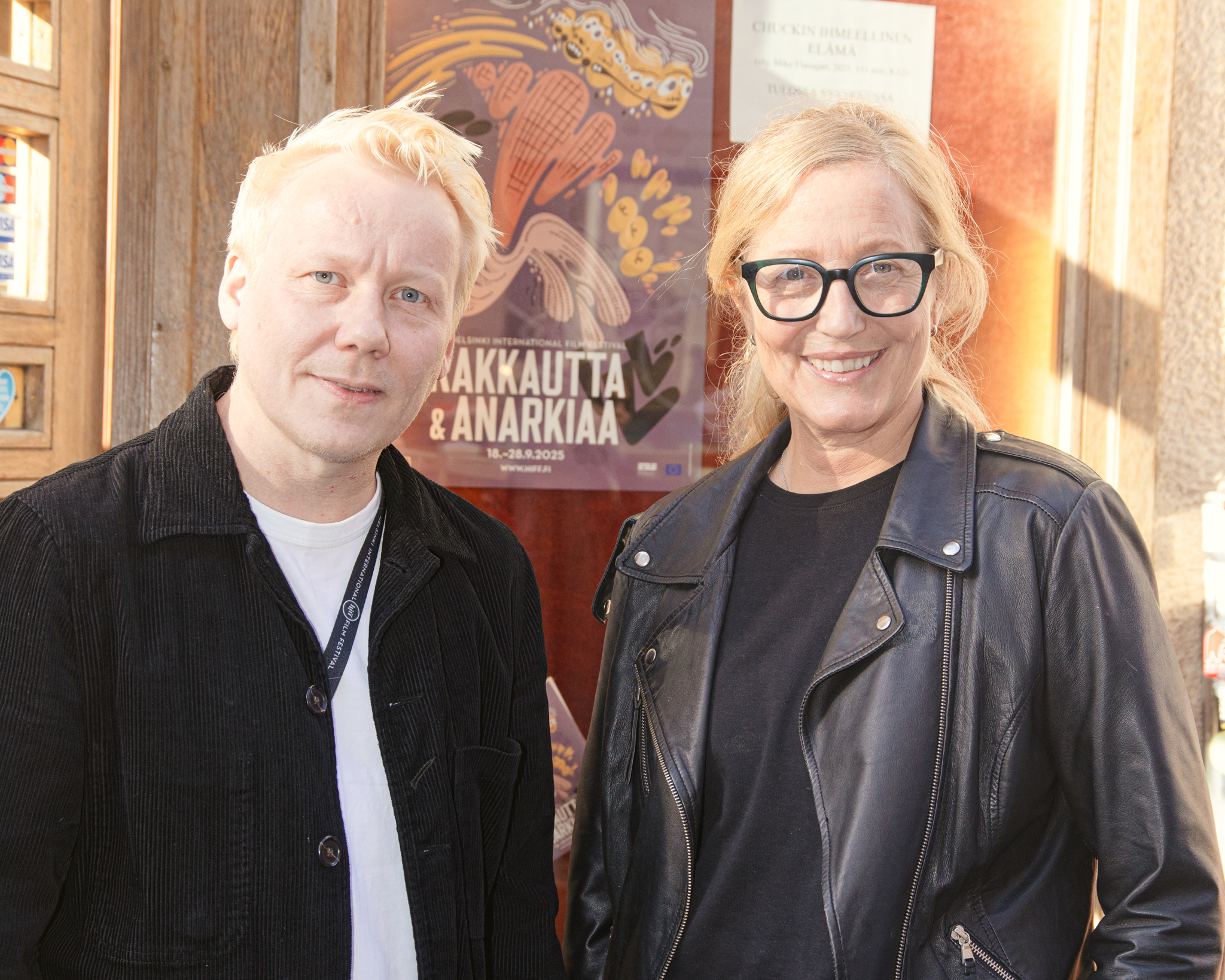
When Lindis Hurum told friends in Norway what she had experienced on Christmas Eve, 2013, they immediately knew the story had to be made into a movie. “I said it’s never going to happen, I had no need or wish to center myself. Also I thought it would be a horrible movie,” Hurum laughs. Fast forward to 2016, when Hurum’s memoir Det finnes ingen de andre — det er bare oss (There Is No One Else — There Is Only Us) came out. Her friends, one of whom is a movie producer, circled back to the idea, and Hurum reluctantly said yes. “The distance to the event helped. And I met Eirik [Svensson, the director] and thought ‘maybe it wouldn’t be horrible’. Eirik was curious and humble and asked the right questions. He wanted to explore biases and invite voices in.”
Hurum and Svensson were in Helsinki screening Safe House, the suspenseful thriller that fictionalizes the incident from one chapter of Hurum’s book: as the director of a medical clinic in a refugee camp in the Central African Republic, she was plunged into a life-or-death crisis when a Muslim man sought shelter in the clinic. Christian militias were hunting the man and besieged the clinic for 15 hours, with Hurum and her staff facing the ethical dilemma of saving one life or many while racing against the clock to keep routine care going, delivering babies and bandaging gunshot victims.
Though Hurum is a country director for Doctors Without Borders in Norway, the organization is not specifically shown or mentioned in the film. “It’s inspired by Doctors Without Borders, but it was better not to use it in the film. This way we didn’t have to be responsible, but we had the liberty of art and expression,” says Hurum. At the same time, the filmmakers wanted the film to be credible for doctors and staff as well as Central Africans. They built as much of the refugee camp as was feasible, on set in Cape Town, South Africa. “When I first saw the set,” says Hurum, “I thought ‘give me two or three days and we can receive patients’. It was so realistic.”
The experience, Hurum says, was also a “mind fuck”: if this is fake, then what is real? “I had such a strong reaction when test shooting with Kristine [Kujath Thorp, who plays main character Linn]. She was wearing what I wore, even the way she moved looked like me. That’s when it hit home, it felt like The Truman Show. What is real, did I experience this?”
Authenticity was also key for director Svensson. He insisted that they find actors from the Central African Republic. Bibi Tanga, who plays Linn’s local assistant Marcel, also served as a cultural consultant who supplied some dialogue in the local language Sango. It was clear to Svensson that the original all-English script needed Linn’s native Norwegian as well as French, used to communicate between foreigners and locals.
When Svensson was asked by the producers if he was interested in the project, he knew very little about the Central African Republic. “I read the script, then Lindis’ book. I knew I had a blindspot to many African conflicts. They are less talked about in the media and they affect us less. I got the reverse feeling, like ‘why don’t I know more, why is this new to me?’. And then I had an urge to lift this story up, in the most honest way I could, to be realistic, respectful and engaging. To use the tools of film fiction where even a 14-year-old in Norway can get it.”
Svensson and Hurum have screened Safe House around Norway, talking to school children to “think of the responsibility of wellbeing of other people that we don’t know. The film doesn’t stop with a happy ending, because then you would have the feeling of ‘case closed’. We want to open up the minds of the audience that this work doesn’t stop, it’s continuous.”
The original title of Safe House in Norwegian is Før mørket, “before dark”, and light plays an important role throughout the film. “Darkness means curfew, because everything is dangerous there after dark, and it’s breaking protocol” to stay at the clinic at night, says Hurum. Near the equator you don’t need a watch to tell time. “The light really shifts and you can feel it.” The impending doom of darkness and the feeling that time is running out are literally on-screen, with a timer seen in various parts of the film. Svensson credits director of photography Karl Erik Brøndbo with finding the natural light and rich colors of the darkness.
The events that spanned 15 hours in real life were compressed into one-and-a-half hours on film, with Svensson acknowledging that there are lots of decisions to cut parts of the story and still keep it engaging and multi-faceted. Svensson’s method of working with non-fiction material is to think of it like a walk down a hallway. “There’s a story behind every door. When it’s true, not fiction, you can ask me and I can tell you what it looks like, smells like, behind every door–every apartment is already furnished. Knowing what’s behind the door gives texture and information, even if you choose not to enter. You’re thankful that you know what’s behind. Reality is so insane, but I’m not intimidated. It’s an advantage.”
Bringing Safe House to the Helsinki International Film Festival is a homecoming of sorts for Svensson. He spent one year studying at Helsinki’s Metropolia University of Applied Sciences. His first short film from that time was screened almost exactly 20 years ago in Cinema Orion, where Safe House was also shown on the second Friday during the Festival.
Looking back, Hurum admits she made the wrong decision on Christmas Eve, 2013. At stake was not just one man’s life, or her own or the team’s lives, but those of the 100,000 people in the refugee camp who would not get health care if the clinic was forced to close. “Leaving was impossible but staying was irresponsible. We wanted the audience to know this was not just one incident, it’s one of many. Every day could end well, so there’s no reason to stop. There is hope in that, teamwork to be done and lives to save,” says Hurum.
After watching Safe House, Hurum hopes the audience would do two things: first, Google the Central African Republic. And second, ask themselves, what would I have done? Hurum thinks most would choose, as she did, to try to save a hunted person. “There is a humanitarian imperative, a duty to help people in need, which is now not seen as a value that everyone agrees on,” says Hurum. “It’s a fight we all have to take on.”
Amanda Alvarez