The momentum builds steadily until the credits roll on the screen! The second half of the Love & Anarchy festival has seen an abundance of discussions about films, filmmaking, and the themes behind movies – not to mention games, galas, and music.
Talking activism
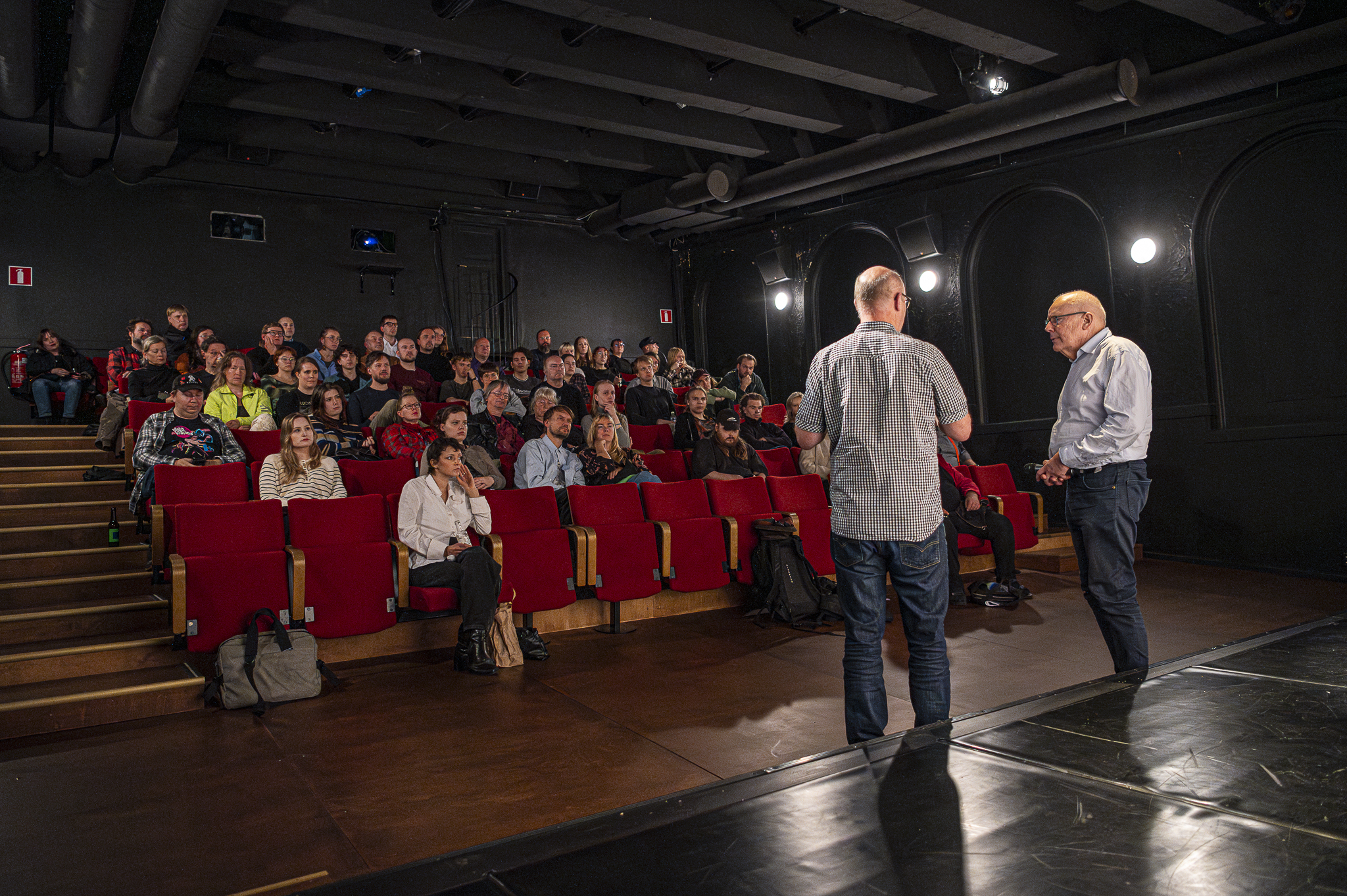
On Wednesday evening, the documentary Once Upon a Time in a Forest, directed by Virpi Suutari, was screened at Puistokatu 4. The film, both beautiful in its storytelling and open to interpretation, sheds light not only on the alarming state of Finland’s forests but also on the mindset of young activists.
The discussion, moderated by Minttu Jaakkola, executive director of Puistokatu 4 (a Space for Science and Hope), featured director Virpi Suutari alongside activist-researchers Otto Snellman from the University of Helsinki and Sonja Pietiläinen from the University of Oulu. The conversation touched on topics such as activist identity, the power of activism, and whether a researcher can also be an activist. Suutari also shared her own activist background as a young student involved in radical feminist movements. Through her film, she tried to reconnect with “the activist Virpi I used to be.” She mentioned receiving feedback from viewers who said the film had helped them better understand activists.
Trivia and tunes at the R&A Club
How comforting it was to slip into the perfect midweek pit stop at Wednesday’s R&A club at Semifinal! Created and hosted by Konsta Heikkinen from the University of Helsinki Film Society, the movie quiz was a perfect match for a week spent immersed in films, offering a challenge even for the most seasoned cinephiles. Throughout the evening, festival-goers could casually chat with each other, exchange movie recommendations, and enjoy alternative rock from the Finnish-Irish band Faraway Shapes.
The best were awarded at the National Competition Award Gala
Thursday evening at Lasipalatsi Bio Rex started with a bang as filmmakers gathered in a private event at the National Competition Award Gala. The jury awarded six Finnish short films at the event.
This year’s jury included actress Saara Kotkaniemi, last year’s public vote winner, director Fabian Munsterhjelm, and filmmaker Ima Iduozee.
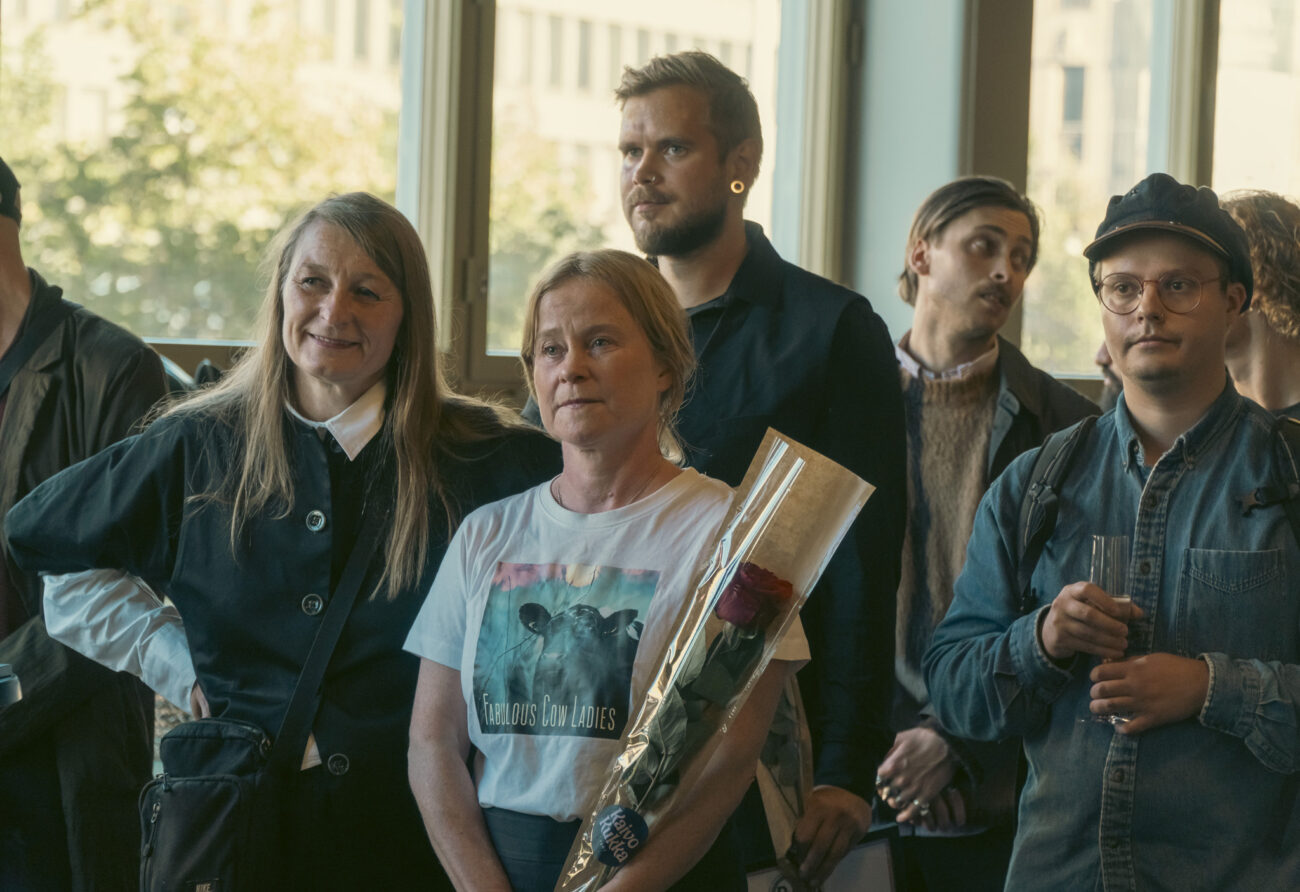
The Jury gave a Special Mention to Iiti Yli-Harja’s film I Smell a Mouse and the Audience Award was given to Mia Halme’s documentary Fabulous Cow Ladies. Juho Reinikainen’s Je m’appelle Mariia was awarded as Best Student Film. Reinikainen thanked the viewers of the film and gave a round of applause to the producer Hadi Nikzad and composer Matti Ahopelto. The Moving People and Images Award went to Kardo Shiwan’s film Fur Fur and The New Wave award winner was Iivo Korhonen’s Morning Has Broken, Yet It is Night.
The R&A Shorts Award went to Elina Talvensaari’s documentary How to Please, accompanied by loud applause. While making the film, Talvensaari found out many things about Finnish immigration policies that made her upset. The process was not always easy even though the topic is important. Talvensaari hopes that as many people as possible would see her film so that the topic – structural racism in Finland – would get more visibility.
Brand new Almodóvar at the Masters Gala
It was once more a full house at Bio Rex on a leisurely Saturday afternoon, as Pedro Almodóvar’s brand new film The Room Next Door was screened at the Masters Gala. Pekka Lanerva introduced the film, which premiered in Venice just three weeks ago, winning the Golden Lion. It was added to the R&A program as a surprise after the announcement of the other gala films.
A more fitting screening for the new Almodóvar would have been hard to imagine. The audience was treated to the director’s signature stylised melodrama, stunning costumes and sets, as well as larger-than-life female protagonists. This time, Almodóvar’s characteristic dialogue was in English, with the lead roles masterfully (pun definitely intended!) portrayed by Tilda Swinton and Julianne Moore.
“Film Conveys Experiences Beyond Words”
Saturday’s program kicked off with Coffee with Filmmakers, where directors Helan Stéfánsdottir and Hannaleena Hauru, along with actor Jacob Skyggebjerg, met at Juova taproom to discuss the latest trends, challenges, and future of the film industry. The well-attended event sparked lively conversations about the role of female directors in cinema, sources of inspiration for filmmaking, and securing funding. The discussion was moderated by Johanna Råman, executive director of DocPoint.
The panel highlighted the creators’ experimental backgrounds: Hauru and Skyggebjerg emphasized the importance of improvisation and working with small budgets as a driving force for creativity, while Stéfánsdottir, a former dancer, spoke about how her artistic practice is rooted in movement and visual art. For all of them, their path to filmmaking began at an early age with a passion for imagining other worlds, expressing themselves, and escaping the narrow-mindedness of small-town life, where acting, for instance, might have been considered even sinful.
Skyggebjerg and Stéfánsdottir criticized the film industry’s funding decisions but also pointed out how working with a limited budget can foster a level of creativity that big-budget films often don’t reach.
The panelists also discussed the role of filmmakers in society. What do they bring to the table? Films show rather than tell, teaching audiences to approach different phenomena in new and unexpected ways. Films convey experiences beyond words, helping us understand a world that often feels chaotic.
What role do audiences play in supporting experimental cinema? The creators’ answer was simple: challenge yourselves.
“Go see films you might not necessarily want to see. They could expand your mind,” Skyggebjerg concludes.
The sound of autumn
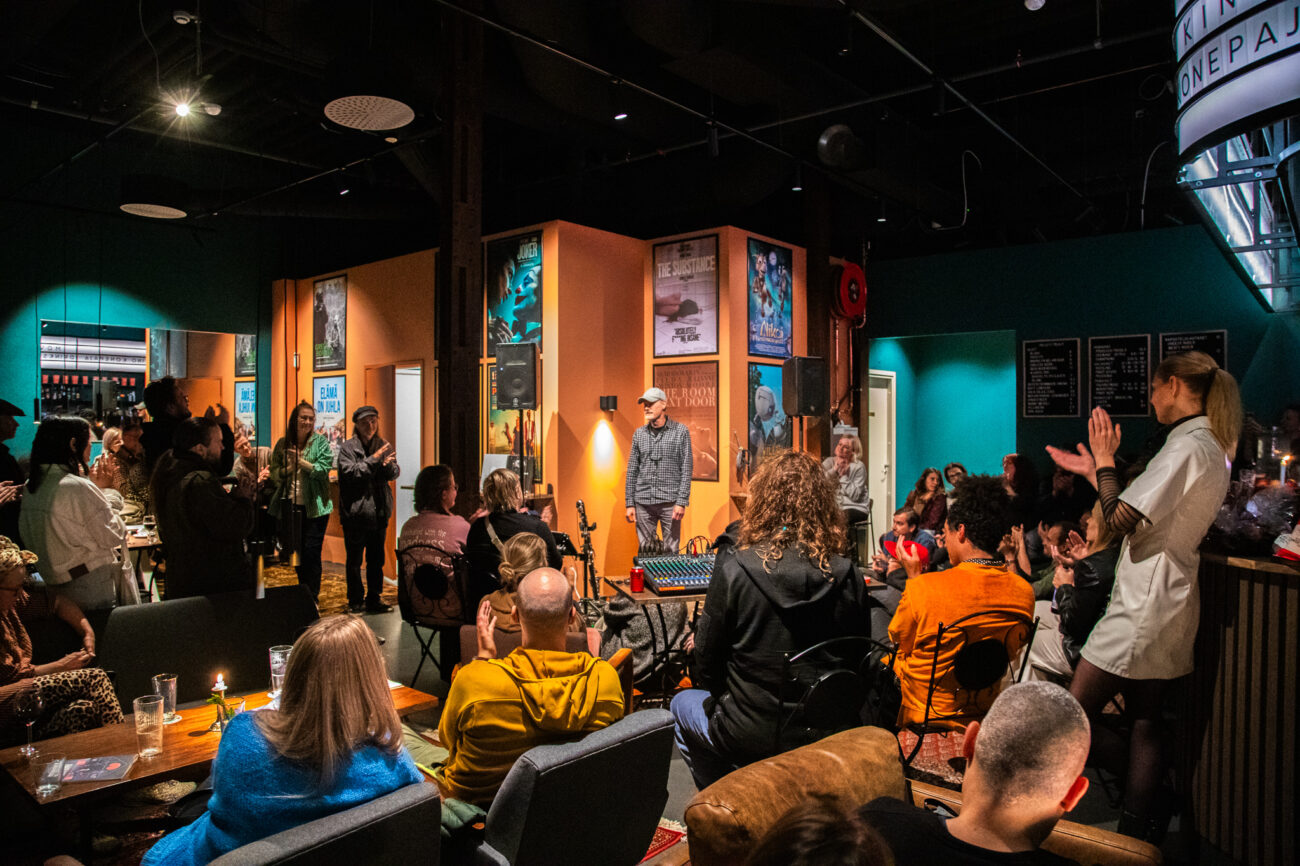
The foghorn-like note played by the saxophonist cut through the thick atmosphere of tension and anticipation in Kino Konepaja. The solo performance by Tapani Rinne – a legendary Helsinki-based musician, composer, and producer – provided an almost bodily experience that captivated the audience for the entire hour-long show.
At the end of the evening, Tapani Rinne and his sound mixer Aleksi Myllykoski stayed for a conversation with the audience. The space was filled with warmth, even though autumn is already beginning to cool down.
The final evening’s gala films
The queues were winding down the lobby of Lasipalatsi Bio Rex, when the sold-out Groundbreaker Gala of the festival, Emilia Pérez directed by Jacques Audiard, was about to start. The opening words of the gala were delivered by Pekka Lanerva, the Artistic Director of the Helsinki International Film Festival, who thanked the Finnish distributor of the film, SF Studios, who made great efforts to get the film to the festival.
Audiard’s films are not a new sight at the R&A festival, but the musical shown in the Groundbreaker Gala was surprising – a film that one would not have expected from the director. Emilia Pérez is a musical originally planned as an opera. Lanerva hailed the film as one of the number one films at Cannes. The evening’s show was given the name Groundbreaker Gala especially due to the unique and boundary-breaking role of the lead actress Karla Sofía Gascón. The cast won the ensemble award at the Cannes Film Festival, and Gascón was the first trans woman in the festival’s history to receive the award.
A couple hours later, the line winding down at Bio Rex was for the second sold-out gala screening of the night, the suspenseful drama The Seed of the Sacred Fig, which was the festival’s Closing Gala. The film is a timely and Cannes-winning take on the fight for women’s rights in Iran. Director Mohammad Rasoulof has had to flee his home country of Iran, where he has been sentenced to prison.
At the beginning of the screening, R&A festival’s Executive Producer Claire Delhom, Programme Manager Outi Rehn and Artistic Director Pekka Lanerva took to the stage. They thanked everyone who participated in the Helsinki International Film Festival fundraising campaign. The year 2024 has been the best year for the festival since the pandemic. More than 55,000 visitors attended the festival, and almost a third of the shows were sold out. Audience favorites were Evil Does Not Exist, Flow and I Saw the TV Glow. Delhom welcomed the entire festival working group to the stage accompanied by applause and also thanked the festival’s partners, cinemas, distributors and filmmakers. THANK YOU!